

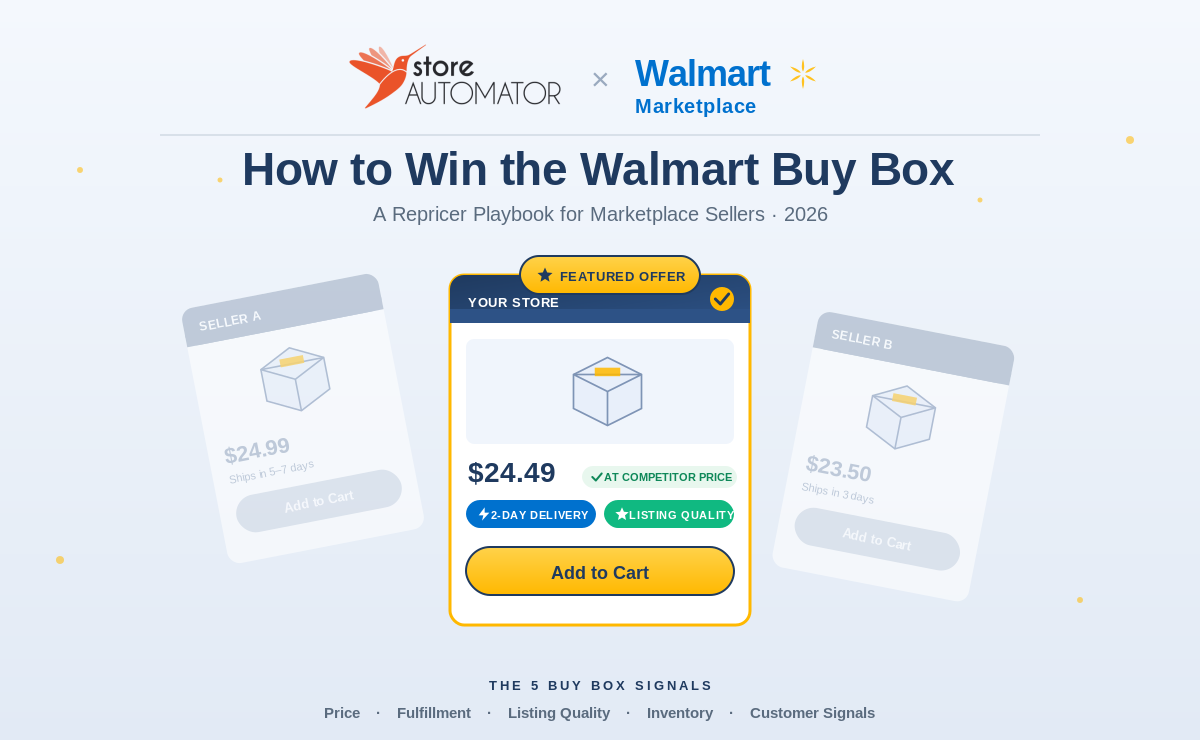
If you sell on Walmart Marketplace, the Buy Box is where you make money. It is the slot directly beside the "Add to Cart" button on a Walmart product detail page, the spot where, by default, every shopper transaction is routed to a single seller. Win the Buy Box, win the sale. Lose it, and your listing is essentially invisible, no matter how good your price.
In 2026, the rules of the game are tougher than ever. Walmart's algorithm has tightened around fulfillment speed, listing quality, and price competitiveness, and shoppers expect Amazon-grade experiences on every Walmart Product Detail Page (PDP). Manual repricing, pulling up a spreadsheet at the start of each week, and adjusting prices by hand does not keep up.
This playbook walks through how the Walmart Buy Box actually works, the five signals Walmart weighs, when to switch from manual to automated repricing, and a practical week-one checklist you can run with. As a Walmart Marketplace Partner, our team has spent years helping sellers build out their Walmart catalogs and stay competitive with the Buy Box, and the patterns below are what we see drive results.
What is the Walmart Buy Box (and how is it different from Amazon's)?
Walmart calls it the "Featured Offer," but most sellers still know it as the Buy Box, the same idea you see on Amazon. When more than one seller offers the same SKU, Walmart's algorithm picks one offer to feature directly under the "Add to Cart" button. Every other seller is pushed to a secondary list that very few shoppers ever click.
Two things make Walmart's Buy Box different from Amazon's:
- Rotation cadence. Walmart has historically rotated the Featured Offer more aggressively. A single SKU can switch winners several times a day depending on price and inventory signals.
- Composite scoring. Walmart weighs fulfillment speed, listing quality, and customer experience together. Price alone is rarely enough. A seller with a slightly higher price but Two-Day Delivery and rich content will often win over a cheaper offer that ships in 5–7 days.
In practice, this means winning the Walmart Buy Box is a multi-variable optimization, not a price race.
The five signals Walmart weighs
Walmart does not publish an exact ranking formula, but the patterns we see across our Walmart Marketplace customers and Walmart's own seller documentation consistently point to five inputs.
1. Price competitiveness
Walmart compares your offer not only to other sellers on Walmart but also to the same SKUs' prices on other major marketplaces and direct retailer sites. The marketplace's Pro Seller Badge Program reinforces this. Walmart wants the lowest sustainable price for the shopper. "Sustainable" is the keyword. Repricing yourself into a loss does not help you, and Walmart's algorithm penalizes erratic price swings.
2. Fulfillment speed and reliability
TwoDay and NextDay Delivery badges are Buy Box gold. If you can offer two-day shipping (via Walmart Fulfillment Services or your own fulfillment network that meets Walmart's standards), your odds of winning the Buy Box jump significantly. On-time delivery rate, valid tracking rate, and order defect rate all feed into this signal.
3. Listing quality (content health)
Walmart's Listing Quality system scores every PDP on completeness, attribute richness, image quality, and content depth. Walmart's stated goal is for seller listing quality scores to clear a 75% benchmark. Sellers who consistently exceed Walmart's listing quality benchmarks win the Buy Box more often and gain more organic search visibility on Walmart.com. Built right, your PDPs should clear that bar on the first listing pass without a back-and-forth of rejected feeds.
That's where StoreAutomator earns its keep on this front. Sellers running their Walmart catalogs on our platform consistently land well above the 75% listing quality benchmark, and the operational result is exactly what Walmart's Buy Box algorithm rewards: PDPs that go live the first time, Featured Offer share that holds steady week to week, and more items surfacing in Walmart's organic search. We don't hit those numbers by polishing listings one at a time. The platform validates every catalog against the latest Walmart Item Spec, enforces required attributes before publishing, and flags common rejection triggers upstream so they never become a feed failure.
4. Inventory reliability
Out-of-stock items lose the Buy Box instantly. More subtly, oscillating inventory (jumping from in-stock to zero and back several times a week) damages your seller score. Walmart wants to feature sellers who can consistently ship the orders they win.
5. Customer experience signals
Order defect rate, cancellation rate, return rate, and seller rating all roll into your Walmart seller scorecard. A stretch of high cancellations or negative reviews will push your offers out of the Buy Box even if your price and content are strong.
Manual repricing vs. automated repricing — when each makes sense
Plenty of Walmart sellers start out repricing manually. It works while you have a small catalog and limited competition. Once you cross a few hundred SKUs or face active price changes from competitors, manual repricing breaks down.
|
Approach |
Best for |
Where it breaks |
|
Manual (spreadsheet) |
< 100 SKUs, slow-moving categories, brand-controlled pricing |
Falls behind in competitive categories; misses price changes between checks |
|
Rules-based repricer |
Mid-size catalogs, sellers with clear margin floors |
Reactive only; cannot anticipate competitor moves |
|
Algorithmic / Buy Box-aware repricer |
Large catalogs, multichannel sellers, contested categories |
Higher setup investment; requires good data on competitors and margins |
Most growing Walmart sellers eventually land on a hybrid: an automated repricer that runs by default, with manual overrides for promotional periods or strategic SKUs.
How a Walmart Repricer Actually Works
A Buy Box-aware Walmart repricer pulls in three streams of data and acts on them in near real time:
- Marketplace signals: current Walmart Featured Offer status per SKU, your competitors' prices, and where you stand against them.
- Your business rules: your floor (the lowest price you will ever sell at, usually cost + minimum margin), your ceiling (the highest price you will go to), and your target Buy Box win rate.
- Multichannel context: if you sell the same SKU on Amazon, eBay, or your DTC site, the repricer keeps prices coherent, so you do not undercut yourself across channels.
When a competitor drops their price, a good Walmart repricer reacts in seconds, but only within your floor and only by the minimum step needed to take the Buy Box back. When a competitor goes out of stock, the repricer can let your price drift back up automatically to capture margin.
Common Walmart Buy Box Mistakes (and how to avoid them)
- Racing to the bottom. Setting your floor at cost-plus-pennies invites every competitor to follow you down. Your floor should reflect the target margin, not the survival margin.
- Ignoring fulfillment speed. If your delivery promise is 5–7 days, while your competitor offers TwoDay, lowering your price further will not win you the Buy Box. Fix shipping first.
- Stale price updates. Repricers that only run once an hour leave you exposed during fast-moving sales events. For competitive categories, look for repricers that act in seconds.
- Letting listing quality slide. A perfectly priced offer on a half-empty PDP still loses to a slightly more expensive one with rich content and high listing-quality scores.
- Over-repricing. Walmart penalizes erratic price changes. A repricer with too-aggressive rules can hurt rather than help.
The Multichannel Dimension: Keeping Walmart, Amazon, and eBay in sync
Most successful Walmart sellers also list on Amazon, eBay, and increasingly TikTok Shop. That creates a coordination problem: each marketplace has its own Buy Box logic, and a price change you make to win the Walmart Buy Box can quietly cost you the Amazon Buy Box on the same SKU.
A multichannel repricer solves this by treating prices as a system rather than a per-marketplace setting. Set your global floor and ceiling once, define per-marketplace targets, and let the engine balance them. The same approach extends to inventory: a single source of truth pushed to every marketplace, so winning the Buy Box on Walmart never sells inventory you have already promised to Amazon.
How to measure Buy Box win rate
Three metrics matter. Track them weekly:
- Buy Box win rate: the percentage of time your offer is the Featured Offer on Walmart, weighted by SKU traffic. Aim for 70%+ on your priority SKUs.
- Impression-to-order conversion: Comparing impressions to orders shows whether the Buy Box is actually translating to sales. A rising win rate with a flat conversion suggests a content or shipping problem.
- Margin trend: If your repricer is pulling prices down without holding margin, you are winning the Buy Box at a loss. Track this together with the win rate.
Frequently asked questions
What is the Walmart Buy Box?
The Walmart Buy Box (officially the Featured Offer) is the seller's offer that appears next to the "Add to Cart" button on a Walmart product detail page. When multiple sellers list the same SKU, only one wins the Featured Offer at a time. The winning seller captures nearly all of the sales on that listing.
Is winning the Walmart Buy Box only about price?
No. Walmart weighs price, fulfillment speed, listing quality, inventory reliability, and customer experience signals together. A slightly more expensive offer with TwoDay shipping and rich PDP content often beats a cheaper offer with slower shipping.
Do I need a Walmart repricer?
If your catalog is small or your category has little price competition, manual repricing can work. Once you reach roughly 100 SKUs or operate in a competitive category, an automated Walmart repricer becomes essential because competitors' prices change too often for any team to keep up manually.
How fast does a Walmart repricer need to act?
In competitive categories, look for a Walmart repricer that reacts in seconds rather than hours. Repricers that only run on a daily or hourly schedule will leave you exposed during fast-moving sales events.
See a Walmart Buy Box-aware repricer in action
StoreAutomator is a Walmart Marketplace Partner. Our repricer adjusts prices in seconds, respects your floors and ceilings, and keeps Walmart, Amazon, eBay, and your DTC store in sync. Sellers using us consistently exceed Walmart's listing quality benchmarks — translating into better Walmart search visibility, faster time-to-revenue, and more time spent winning the Buy Box.
Want to see the repricer running on real Walmart SKUs? Book a 30-minute Walmart-focused demo, and we will walk through your top priority listings together.