

Last March, we spent a few days on the floor at the Prosper Show in Las Vegas, demoing StoreAutomator to brands and resellers, many of them mid- to large-sized operations running thousands of SKUs across multiple channels. The conversations were energizing. Seller after seller told us the same thing: their current legacy listing platform wasn't keeping up. It was too rigid, lacking the multichannel listing and order-management depth they needed, and it didn't integrate cleanly with the backend systems they relied on, from NetSuite to DEAR to Unleashed. They wanted more, and they could see StoreAutomator was built for it.
Then we watched what happened over the following months. Despite real frustration with their tools, many of those sellers stayed put.
Not because they'd changed their minds about needing something better. Because one fear outweighed everything else: the fear of migrating their data, and the more we talked with them, the clearer it became that this single concern, not price, not features, is the number one reason ecommerce sellers don't switch platforms even when they genuinely want to.
Why "I'll switch later" really means "I'm scared of the move"
When a seller says they're not ready yet, they're rarely talking about your product. They're doing quiet math on everything that could go wrong between today and a working new system. And honestly? Their fear is rational. Here's what's actually keeping them up at night.
Thousands of SKUs that don't map cleanly. Product data in a legacy listing platform is never tidy. Variants, parent-child relationships, category mappings, channel-specific attributes, and custom fields have all been shaped over the years to fit the old system's logic. The dread isn't uploading a spreadsheet; it's the suspicion that half the attributes won't line up on the other side and someone on a lean team will spend nights fixing it by hand.
Live listings, they can't afford to break. Every active listing represents ranking, reviews, Buy Box position, and revenue. Sellers imagine a botched migration knocking listings offline during peak season, or resetting hard-won channel history. The status quo feels safe precisely because it's already running.
A backend stack that took years to wire up. This is the one most platforms underestimate. These sellers aren't just on a listing tool; they've connected it to an ERP or inventory system like NetSuite, DEAR, Unleashed, Finale Inventory, Aptean, or AIMS360. Switching listing platforms feels like it threatens that entire web of integrations. If the inventory sync or order flow to the backend breaks, the whole operation breaks.
Contracts that punish leaving and the double-pay trap. Many are mid-term on an agreement, so switching means either paying an early-termination cost or running two platforms in parallel for a stretch. Either way, it reads as "pay twice to do more work," which is a hard internal sell, even when the long-term savings are obvious.
No bandwidth to run the migration themselves. The teams that most need a better platform are the ones already stretched thin. They hear "migration" and picture it landing entirely on their plate, on top of running daily operations. That perceived workload, more than money, is what freezes the decision.
How a supported migration turns "later" into "now"
The way to beat fear of migration isn't to pretend it's easy. It's to take the work and the risk off the seller's plate. That's exactly how we approach every transition.
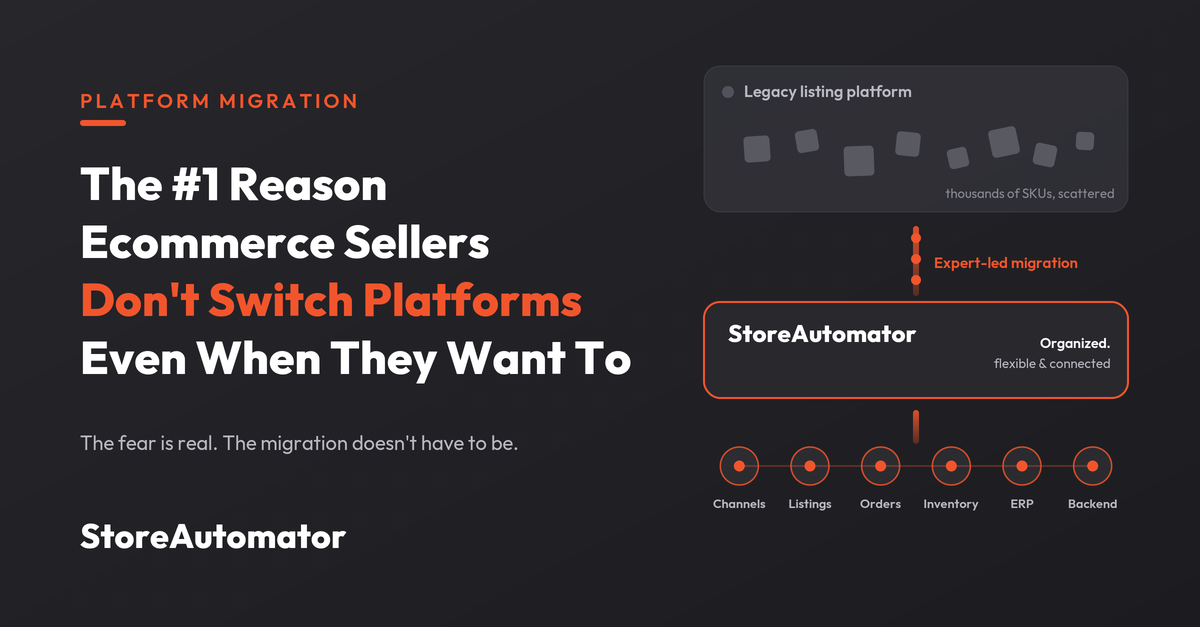
Your messy SKU data becomes our problem, not yours. Our onboarding team handles the heavy lifting of mapping thousands of SKUs, variants, parent-child relationships, category structures, and channel-specific attributes into StoreAutomator. The platform is built to be flexible enough to adapt to your existing data structure, rather than forcing you to reshape years of work to fit rigid templates. You review and approve; you don't rebuild.
Live listings stay live. We plan migrations to protect what's already earning, your rankings, reviews, and Buy Box position. The transition is staged and tested so listings don't go dark, and channel history isn't lost. The goal is continuity, not a risky overnight cutover.
Your backend stack stays connected. This is where flexibility matters most. StoreAutomator integrates with the systems you've already wired into your operation, NetSuite, DEAR, Unleashed, Finale Inventory, Aptean, AIMS360, Stone Edge, and more, so inventory sync and order flow keep running. Switching your listing platform doesn't mean rebuilding your ecosystem around it.
A migration period designed around your contract. We work with you on timing so the move fits your existing agreement and minimizes any overlap. The transition is structured as a guided period, not a scramble, so "I'm locked in until next quarter" becomes a scheduling detail rather than a dealbreaker.
Our experts carry the workload, so your team doesn't have to. This is the part that changes the decision. You don't hand migration to an already-stretched team and hope. A dedicated onboarding and support team guides you through the process step by step, while your people keep the business running. The workload you were dreading is largely ours.
The real cost of standing still
Here's the part that's easy to miss when fear of migration takes over: staying put isn't free. Every month on a platform that can't keep up has a price: listings that aren't optimized across channels, orders managed with workarounds, a backend that needs manual babysitting, and growth you're leaving on the table because your tools can't support it. That cost is just quieter than the one-time effort of switching, so it's easier to ignore.
Migration, done right, is a one-time, supported, finite project. The limitations of the wrong platform are a tax you pay every single day.
The sellers we met at Prosper Show weren't wrong to be cautious. They were weighing a vivid, short-term fear against a cost that compounds silently in the background. Once the fear is addressed by a team that owns the move with you, the decision becomes much simpler.
Let's make the move the easy part.
If you've been wanting to switch but the migration is what's holding you back, that's exactly the conversation we're built for. Let our team walk you through what a transition would look like for your catalog, channels, and backend stack. No guesswork, no pressure.
Talk to our onboarding team for a free migration assessment, and see how smooth the move can really be.